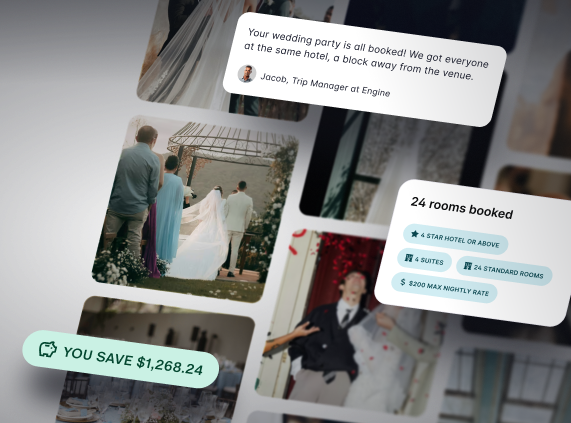
The wedding weekend is replacing the wedding day: here's what that means for your hotel block

Love is everything, and it’s worth celebrating. Couples are stretching their love stories into three-day events. But while a weekend-long party sounds like an absolute dream, it introduces a whole new set of logistics for your guest accommodations.
Here is your ultimate guide to mastering the multi-night hotel block for your wedding weekend, ensuring your guests stay comfy, your budget stays safe, and your celebration goes off without a hitch.
What You Actually Need to Know
- Weddings are transitioning from single-day events into three-day weekend experiences (Welcome Party + Wedding Day + Farewell Brunch).
- Your hotel block is no longer just a place for guests to crash after the reception; it is the central hub for your entire wedding weekend.
- Multi-night blocks change the math on hotel contracts. You will need to negotiate different attrition rates (the percentage of rooms you are legally locked into filling) and leverage longer stays for better perks.
- Using a specialized service like Room Blocks by Engine takes the contractual headache off your plate so you can focus on the fun stuff.
Why the wedding weekend is the new default
Huge weddings? Fairytales exist for a reason, because everybody loves them. They are incredible memories for the couple and everyone invited. A great opportunity to dress and celebrate love. It also costs a lot of money.
One-day weddings? Fairytales also are private, small. Love is celebrated in the intimacy of the couple, another great opportunity to dress and celebrate love. This costs a little less money, but doesn’t allow
The wedding weekends are the sweet spot to keep a budget friendly wedding while also allowing for the people you love the most to gather and celebrate with you.
The numbers reflect the shift. Among destination couples, and even for local weddings trying to do something different, the majority plan a formal welcome event with some industry surveys putting that figure as high as 99%, turning what was once a single ceremony into a three-to-five-day celebration. Welcome cocktail receptions, group dinners, day-after brunches, and shared activities have gone from wowzers to expected.
Stretching the party means shifting the strategy. When you turn your wedding into a mini-vacation for your guests, the venue becomes just one of a list of essentials. Accommodations as a whole, with all of their offers, are the new default and anchor of the entire weekend wedding.
The Rise of the Multi-Event Wedding
A wedding weekend in a nutshell is:
Friday | Welcome Party: The first gathering. Guests arrive, meet each other, shake off the travel. The pressure is low, the mood is warm. This sets the tone for everything that follows.
Saturday | The Wedding Day: The main event. Because guests have already had a night together, the ceremony and reception feel different, more like a reunion than a room full of near-strangers.
Sunday | Farewell Brunch: The soft landing. A chance for the couple to see people they barely got to talk to the night before, and for guests to close the trip on a high note rather than an abrupt goodbye.
Here comes the ̶b̶r̶i̶d̶e̶ room block
Once you commit to a wedding weekend, your guests need a place to crash, and how you handle their rooms sets the vibe for the whole trip.
For one night? Easy.
For a full weekend? It’s a whole different thing filled with multi-night contracts and sneaky costs. Done right, you get yourself a wedding for the ages. Done wrong, it’s all chaos and bureaucracy.
Courtesy Block vs. Contracted Block: Know the Difference
Before you sign anything, understand which type of block you're entering into, because the financial implications are very different.
Courtesy Block: The hotel reserves rooms for your guests at a discounted rate, but there is no financial penalty if guests don't fill all the rooms. The hotel simply releases unbooked rooms back into general inventory after a cutoff date (usually 30 days out). The catch: courtesy blocks are typically available only for smaller groups (often 10 rooms or fewer per night), and the rates are usually higher than a contracted block.
Contracted Block: You're guaranteed a set number of rooms at a deeper discount, but you are financially responsible for filling a minimum percentage of those rooms, known as the attrition rate. If your guests don't book enough rooms, you pay for the shortfall. This type comes with more risk, but also better rates and more negotiating leverage for perks.
How do I know if the wedding weekend is for me? Multi-Night vs. Single-Night Blocks
Beauty is in the details, and when you’re doing a smaller, quicker celebration, those details and expectations matter even more.
Understanding the possibilities and what you actually could get out of a weekend wedding will help you figure out if you're really looking for a three-day celebration or if you can do your dream wedding in a single day.
The Basic Perks Every Couple Needs
No matter the length of the stay, every wedding couple should look for these baseline amenities:
Comparing Your Options
If you’re still not so sure if you should go for a single-night wedding or a weekend wedding, keep in mind this:
Making Sense of the Numbers: Attrition Math & Negotiation
There comes a time in everybody’s life where you need to sit down and do the math. And so it begins, a less glamorous but essential part of wedding planning: hotel contracts.
Most couples assume hotels throw in perks as part of a room block and with it, the organization process for the entire weekend wedding is simpler. The data tells a more specific story: almost nothing is truly complimentary, but roughly 1 in 4 blocks includes a negotiated discounted rate for breakfast and parking. Knowing the difference changes how you approach the conversation.
Spreading your wedding over a weekend completely changes how hotels view your booking, which means you need to understand the math before you sign on the dotted line.
How Room Blocks Usually Work
Normally, you estimate how many out-of-town guests will need a room, and the hotel sets aside a chunk of inventory at a discounted rate. For a single-day wedding, guests usually check in Saturday afternoon and check out Sunday morning.
For a weekend wedding, your block will likely span from Thursday or Friday through Sunday. Because you are holding inventory across multiple high-demand nights, hotels will often ask you to sign an Open Block contract containing an attrition clause.
What is Attrition and Why Does It Matter?
Attrition is a legal commitment stating that you guarantee your guests will fill a specific percentage of the rooms you reserved. If your guests fail to book those rooms, you are financially responsible for paying the difference.
The standard attrition rate for wedding room blocks is typically 80–90%, meaning you must fill that share of your reserved rooms or pay for the shortfall.
For example, if you reserve a block of 50 room nights across the weekend, an 80% attrition clause means you guarantee that at least 40 of those room nights will be booked and paid for. If your guests only book 35 nights, you have to pay the hotel out-of-pocket for the 5 remaining unbooked rooms.
When you add a second or third night to the equation, the financial risk multiplies. If you guess wrong on how many guests are willing to stay for both Friday and Saturday night, you could end up with a massive hidden expense.
But based in our research, the attrition fear is almost always unfounded. 96% of wedding hotel room blocks carry zero financial obligation, guests book and pay for their own rooms individually, and the couple owes nothing if rooms go unfilled.
Negotiation 101 for Weekend Weddings
Don't let attrition scare you away from a weekend celebration! You just need to negotiate smart terms. Use these rules of thumb when reviewing your contract:
- Lower the Attrition Percentage: Aim to negotiate the attrition clause down to 70% or 75% to give yourself a safer buffer.
- Request a Mitigation Clause: Ensure the contract states that if the hotel manages to resell your unbooked rooms to the general public, those rooms count toward your minimum quota.
- Establish a Slippage Policy: Ask for the right to reduce the size of your room block by 10%–15% without penalty up to 30 or 60 days before the wedding, once your RSVPs start rolling in.
Ready to Make Your Weekend Wedding Reality?
Transitioning your wedding from a single evening into a full-weekend experience is the ultimate gift to yourself and the people you love most. It gives you the time, space, and freedom to soak in every single drop of joy, laughter, and connection without watching the clock.
Just remember that a bigger celebration requires a smarter lodging strategy. By locking in deeper multi-night discounts, keeping a close eye on your attrition math, and leaning on trusted partners to navigate the logistics, you can ensure your accommodation plan is just as seamless and beautiful as your walk down the aisle.
Key Learnings for Your Planning Checklist
- Think big picture: Treat your hotel block as the central hub where your weekend itinerary unfolds.
- Leverage your length of stay: Use those multi-night bookings to secure premium perks like complimentary suites and waived event fees.
- Protect your wallet: Always negotiate your attrition rates down and add a slippage clause to protect against unfiled rooms.
- Delegate the stress: Don't spend hours fighting with hotel sales departments alone.
Your wedding is a once-in-a-lifetime celebration, let's make sure the planning process feels like a dream, too. Let the experts handle the heavy lifting so you can focus on tasting cake, picking flowers, and enjoying every single second of your engagement.
Ready to secure the perfect multi-night hotel block for your wedding guests?




.svg)
BOOKING GROUP TRAVEL WILL NEVER BE THE SAME.