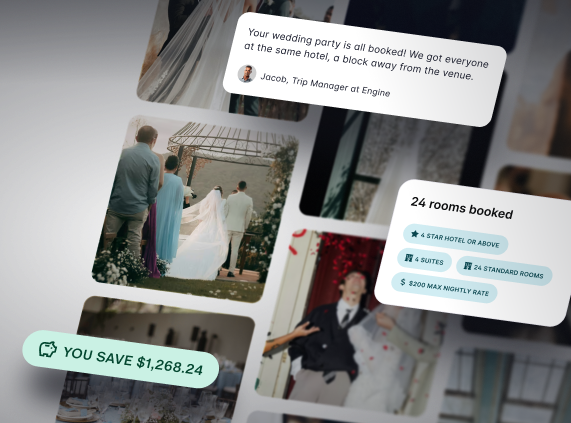
How do I know if I should book a courtesy block or a contracted block for my wedding?

Deciding between a Courtesy or Contracted block usually comes down to one question: Risk or Reward? A courtesy block is the safe, flexible choice with no strings attached. A contracted block requires a bit more commitment, but it rewards you with better pricing and guaranteed rooms for your loved ones.
Most couples land somewhere in the middle. Finding your perfect fit is just a matter of looking at your guest list and deciding how much 'certainty' you need to feel relaxed.
Why wedding room blocks feel so confusing
Hotel room blocks are basically the 'unwritten chapter' of wedding planning: everyone tells you to get one, but nobody actually tells you how.. Suddenly, your to-do list includes 'Master Hotel Logistics.' You’re comparing hotels like Marriott, Hilton, Hyatt, understanding boutique properties, and deciding how much financial responsibility you want to take on, all while juggling vendors and RSVPs.
But once you understand the difference between courtesy and contracted blocks, the process becomes much easier and far less stressful.

What is a Courtesy room block?
A courtesy room block is the most flexible option for couples who are unsure how many guests will need a hotel.
Key features of a Courtesy Block
- No financial commitment or deposit
- Rooms are held until a cutoff date
- Unused rooms are released without penalty
- Typically smaller room counts
- Rates may fluctuate based on availability
Courtesy blocks are common at hotels when they have plenty of open rooms and want to attract group business without a formal contract.
When a Courtesy Block makes sense
A courtesy block is often the best fit if:
- Your wedding is local and many guests live nearby
- You expect fewer than 20 to 25 out of town guests
- Your guest list may change
- You want the lowest stress option
For many couples, especially early in planning, courtesy blocks feel like a relief because there is no risk if fewer guests book.
What is a Contracted room block?
A contracted room block is a formal agreement with a hotel that guarantees rooms for your wedding guests.
Key features of a Contracted Block
- Guaranteed availability at a fixed group rate
- Requires signing a contract
- Often includes an attrition requirement
- May require a deposit
- Often comes with perks or concessions
Hotels like larger chains or popular destination properties tend to prefer contracted blocks for busy weekends.
What is attrition and why it matters
Attrition is the minimum percentage of rooms you agree to fill. For example, if you contract 20 rooms with 80 percent attrition, you are responsible for 16 rooms being booked. If fewer guests book, you may owe the hotel for the difference.
Understanding attrition is critical and one of the biggest reasons couples feel nervous about contracted blocks.
-compressed-q80.avif)
Factors that should guide your decision
1. Your guest count and travel needs
If more than half your guest list is traveling, especially for a destination wedding or holiday weekend, a contracted block often provides peace of mind.
2. Wedding location and season
Busy wedding cities and peak seasons fill quickly. If your wedding is in a popular destination or during peak season, courtesy blocks may sell out faster.
3. Your comfort with commitment
Some couples prefer flexibility over savings. Others want guaranteed rooms and locked in pricing. Neither approach is wrong.
4. Timing
Most couples begin booking room blocks 9 to 12 months before the wedding. Starting early gives you better options and less pressure.
How Room Blocks by Engine makes either option easier
Whether you choose a courtesy block, a contracted block, or a mix of both, Room Blocks by Engine simplifies the entire process.
Instead of emailing or calling multiple hotels, Room Blocks by Engine lets you:
- Compare proposals from several hotels in one place
- Understand rates, terms, and perks clearly
- Avoid confusing contract language
- Get support from a dedicated trip manager
This means fewer surprises and more confidence in your choice.
How your wedding website fits in
Once you’ve navigated the courtesy vs contracted wedding room block decision, sharing it clearly with guests is just as important. Adding your hotel details to your wedding website, especially through a platform like The Knot, makes everything easy to find in one trusted place.
Guests can quickly see where to stay, access booking links, note important deadlines, and explore nearby hotel options. This simple step cuts down on repetitive questions, avoids last minute confusion, and helps guests feel confident about making their travel plans, which means one less thing for you to manage as the wedding approaches.
Common mistakes to avoid
- Contracting too many rooms too early
- Waiting too long to start the process
- Assuming all hotels offer the same terms
- Not understanding the cutoff date
Room Blocks by Engine helps couples avoid these pitfalls by presenting everything clearly before you commit.
Choose confidence over stress
The right wedding room block is the one that fits your guests, your comfort level, and your wedding vision. Courtesy blocks offer flexibility. Contracted blocks offer certainty. Many couples even use a combination.
The most important thing is that you do not have to navigate this alone.
Ready to find your perfect room block without the stress?
Start comparing hotels with Room Blocks by Engine today by first choosing the city where you are getting married, reviewing your options, and letting us handle the rest.



.svg)
BOOKING GROUP TRAVEL WILL NEVER BE THE SAME.