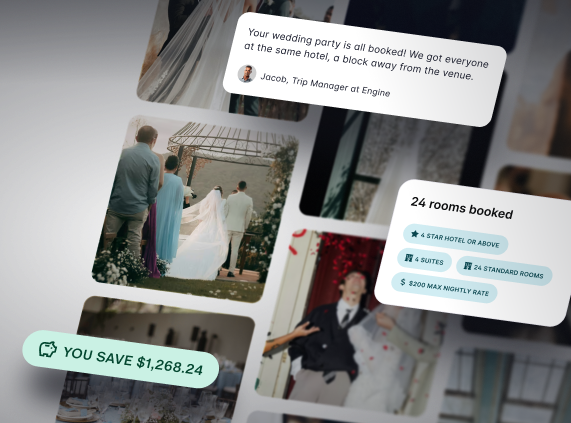
Should we cover rooms for certain guests, and how do we arrange that?

There’s a common wedding myth that 'hospitality' means 'footing the bill' for every guest's pillow. In reality, the most seamless weddings focus their budget on the VIPs while providing everyone else with the ultimate guest luxury: a perfectly organized plan. It’s all about finding that sweet spot where being a generous host and staying on budget actually live in harmony..
If this decision already feels overwhelming, you are not alone. Guest accommodations are one of the most confusing parts of wedding planning, especially when budgets, etiquette, and logistics collide. The good thing is that with the right approach and the right tools, you can make thoughtful choices and keep the process simple.
When it makes sense to cover hotel rooms for wedding guests
Covering hotel rooms is a personal decision, not a rule. That said, there are common situations where couples often choose to pay.
Guests couples commonly cover
- Parents and immediate family members
- Wedding party members like bridesmaids and groomsmen
- Officiants or readers who are close friends or relatives
- Guests traveling internationally or cross country
- Elderly guests who need extra comfort or accessibility
Covering these rooms is often seen as a thank you for their support or a way to ease the burden of travel.
Situations where paying is more common
- Destination weddings
- Weddings in remote areas with limited hotel options
- Multi day wedding weekends where attendance is expected at several events
In these cases, helping with accommodations can feel less like an extra and more like part of hosting.
When guests typically expect to pay for their own rooms
For most traditional weddings in the United States, guests expect to book and pay for their own hotel rooms. This is especially true for:
- Local or regional weddings
- Large guest lists
- Weddings in major cities with many hotel options
Here’s a secret: guests don’t expect a free ride; they expect a plan. Most guests are just relieved they don’t have to find a place on their own. A well-organized block isn’t just a discount; it’s courtesy.
Smart ways to cover some rooms without overcommitting
You do not have to choose between paying for everyone or paying for no one. Many couples use a blended approach.
Option 1: Cover rooms through a contracted block
If you know exactly who you want to cover, you can include their rooms within a contracted hotel block. This means you guarantee a certain number of rooms, often at a lower rate, and assign those rooms to specific guests.
This works well for:
- Parents and immediate family
- A set number of wedding party rooms
It is important to be realistic. Contracted blocks come with responsibility if rooms go unused.
Option 2: Book specific rooms directly
Some couples choose to book and pay for a handful of rooms directly with the hotel, separate from the main guest block. This is common for:
- The couple’s suite
- One or two family suites
- The night before or after the wedding
This approach keeps your guest block flexible while still covering key people.
Option 3: Subsidize instead of fully cover
Another thoughtful option is to partially cover costs. For example:
- Paying for one night instead of the full stay
- Covering rooms only for the wedding night
- Offering a fixed stipend for certain guests
This balances generosity with budget control.
How hotel room blocks make this easier
Trying to manage individual bookings, payments, and guest questions quickly becomes stressful. This is where hotel room blocks are essential.
A room block allows you to:
- Secure a discounted rate for your guests
- Guarantee availability during a busy wedding weekend
- Keep everyone staying in the same area
- Simplify communication and logistics
With Room Blocks by Engine, you can compare multiple hotel options at once, see rates and perks side by side, and understand which block type works best for your situation. You are not guessing or negotiating alone.
How to communicate this clearly to guests
Clarity prevents awkward conversations.
On your wedding website
- Clearly list the hotels with room blocks
- Note if certain rooms are reserved for specific guests
- Avoid mentioning who is or is not covered
For guests whose rooms you are paying for
- Let them know directly
- Share booking instructions or confirm details on their behalf
- Be clear about how many nights are included
Most guests are simply grateful for clear guidance.
Common mistakes to avoid
- Overbooking rooms you might not need
- Waiting too long and losing availability
- Assuming guests will book without reminders
- Trying to manage negotiations on your own
- Paying for rooms without understanding cancellation terms
These are exactly the pain points Room Blocks by Engine is designed to remove.
A calm and confident way to move forward
Deciding whether to cover hotel rooms is about balance, not pressure. You can be generous without stretching your budget, organized without being overwhelmed, and thoughtful without overcomplicating the process.
Room Blocks by Engine helps you compare hotels, understand your options, and choose the safest and simplest path for your wedding weekend. You stay in control, and your guests feel taken care of.
Ready to simplify guest accommodations?
Start comparing hotels with Room Blocks by Engine today. Begin by choosing the city where you are getting married, explore your options, and let us handle the rest so you can focus on what actually matters.



.svg)
BOOKING GROUP TRAVEL WILL NEVER BE THE SAME.