What dates do hotels consider “high demand” for weddings?

Timing is everything! From major holidays to local festivals, certain weekends naturally come with a crowd. In most markets, spring and fall Saturdays are the ultimate 'peak' moments. Understanding these high-demand dates early on ensures your guests have a cozy place to tuck in, no matter how busy the town gets.
For engaged couples, this matters because high demand dates can affect room availability, group rates, contract flexibility, and perks. In other words, the same weekend that feels perfect for your wedding may also be the hardest and most expensive time to reserve hotel rooms for guests.
But this does not mean you need to panic or settle. It simply means you should start early, stay realistic about pricing, and use a process that helps you compare options clearly. Room Blocks by Engine is designed to make that part easier by helping couples request proposals, compare rates and perks in one place, and avoid the back and forth that often makes hotel block planning feel overwhelming.
Why hotels label some wedding dates “high demand”
Hotels look at one big question: How likely is it that rooms will sell easily without offering special concessions?
If the answer is yes, the hotel may be less flexible with group discounts, courtesy blocks, or extra perks. That is why a date can become “high demand” even if it is not technically a holiday.
Common reasons a wedding date is considered high demand include:
- It falls in peak wedding season, especially late spring and fall
- It is a Saturday night, which is often the most requested wedding night
- It overlaps with a holiday weekend
- It coincides with a festival, convention, concert, or sporting event
- It lands on a college football weekend, graduation weekend, or parents weekend in a university town
- It is during a destination’s best weather season
- It overlaps with other heavy travel periods, such as school breaks
This is also why couples may see very different hotel responses between two dates that seem close together on the calendar.

The wedding dates that are most often high demand
Spring and fall Saturdays
In many parts of the U.S., the highest demand wedding dates are Saturday weddings in April, May, June, September, October, and early November. These months are popular because the weather is usually mild, travel is easier, and guests are more willing to attend a full wedding weekend.
If your wedding is on a Saturday in one of those months, hotels may expect strong occupancy even without a room block.
Holiday weekends
Hotels often classify these as high demand because leisure travelers book early and rates rise quickly:
- Memorial Day weekend
- Fourth of July weekend
- Labor Day weekend
- Columbus Day or Indigenous Peoples’ Day weekend in some markets
- Thanksgiving weekend in destination or family travel markets
- New Year’s Eve weekend
A holiday weekend wedding can be beautiful and convenient for guests, but it can also come with higher rates, stricter terms, and fewer courtesy block options.
Local event weekends
Even if your wedding date is not traditionally popular, it can still be in high demand if the city is busy. Think:
- Major conventions
- Marathons
- Music festivals
- Home football games
- Graduation weekends
- State fairs
- Large corporate events
This is especially important in cities with big convention centers or strong event calendars, as well as college towns.
“Pretty” calendar dates
Dates that feel memorable, such as 10/10, 11/11, or 6/7/26, can attract more weddings and more leisure travel. Hotels know couples love easy to remember dates, so those weekends may book faster than usual.
How high demand dates affect your room block
When your wedding falls on a high demand date, hotels may be more cautious about what they offer. You might see:
- Higher nightly room rates
- Smaller courtesy blocks
- Shorter booking windows
- Faster cutoff dates
- Fewer complimentary perks
- Stricter cancellation or attrition terms on contracted blocks
That does not mean you cannot get a good block. It just means you need to look carefully at the full proposal, not just the headline rate. Room Blocks by Engine helps couples compare important details like rates, fees, parking, perks, and requirements side by side, which can make a big difference when demand is high.
Tips for getting the best rates on a high demand wedding date
Be flexible with hotel mix
Not every guest needs the same price point. Many couples do best with two or three hotels instead of one. A mix of options can help, such as:
- A full service hotel like Marriott, Hyatt, Hilton, or Westin for convenience
- A more budget friendly option like Hampton Inn, Holiday Inn Express, or Fairfield Inn
- A boutique hotel for guests who want a more elevated stay
This gives your guests choices and may reduce pressure on a single block.
Ask about shoulder nights
Some guests may want to arrive early or stay later. Ask whether the group rate can apply to extra nights, especially for Friday and Sunday. Many hotels will allow this if inventory is available.
Watch for hidden costs
A low room rate does not always mean a better deal. Review:
- Parking fees
- Resort or destination fees
- Breakfast inclusion
- Welcome bag handling fees
- Minimum stay requirements
- Deposit terms
A proposal with a slightly higher rate but fewer added costs may be better for your guests overall.
Be realistic about room count
One of the biggest mistakes couples make is blocking too many rooms too early. That can create stress if you sign a contracted block with minimum obligations. Starting with a realistic number and adding more later, if inventory allows, is often the safer move.
How to manage RSVPs and avoid room block stress
Guest accommodations can feel messy because hotel booking timelines do not always match wedding RSVP timelines. That is normal.
A few ways to keep it manageable:
Share booking details early
As soon as your block is confirmed, add the booking link or instructions to your wedding website and save the date communication.
Remind guests before the cutoff date
The cutoff date is when unused rooms are released back to the hotel. After that, your guests may still be able to book, but the group rate and availability are not guaranteed.
Track interest, not perfection
You do not need a flawless spreadsheet or exact answer from every guest right away. Estimate conservatively, communicate clearly, and choose a block structure that gives you flexibility.
A simpler way to book a wedding room block
High demand dates can make hotel planning feel intimidating, especially when you are already juggling venues, guest lists, budgets, and RSVPs. That is exactly why couples look for support.
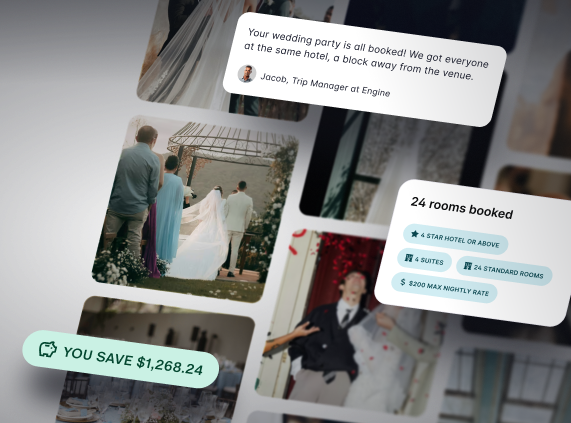
Room Blocks by Engine helps simplify the process by letting couples search hotels near their venue, send requests directly to selected properties, compare proposals in one place, and get support through the final booking steps. The platform is free for couples, which makes it an easy starting point when you want clarity without adding more stress to your plate.
The easiest way to protect your guests’ stay
Hotels consider wedding dates “high demand” when they expect rooms to sell quickly because of seasonality, Saturdays, holidays, or local events. For couples, that means the smartest move is to start early, compare carefully, and choose a room block strategy that fits your guest list and budget.
Ready to find your perfect room block without the stress? Start comparing hotels with Room Blocks by Engine today. Start by choosing the city where you’ll get married, review your options, and make guest accommodations one less thing to worry about.



.svg)
BOOKING GROUP TRAVEL WILL NEVER BE THE SAME.